dentemple 12 hours ago
Don't worry, once the Wall Street tap runs dry, the U.S. government will be more than happy to step in and bail out the AI corps. at the taxpayer's expense.
sethops1 12 hours ago
dataviz1000 11 hours ago
> Don't worry, once the Wall Street tap runs dry, the U.S. government will be more than happy to step in and bail out the AI corps. at the taxpayer's expense.

I have a brilliant idea. Why not start this now?

The US government will give every child born $1000 in money in order to hand it to the small number of families who own 70% of equities in order to purchase equities the child can't touch for 18 years. That is US Government -> child -> rich person who currently owns the equity, although the rich person gets the cash in hand the child has to wait 18 years to sell the equity.

Where does the US Government get this $1000 per child from? Borrow it, adding to the $38,000,000,000,000 in national debt.

Here is the interesting part of my brilliant plan. That child will inherit, calculated per capita, $111,000 in debt the moment she is born. That child will be responsible, calculated per capita, for ~$3,000 a year in interest on that debt.

In order to sell the idea, every time the US Government gives $1000 to a child to purchase stocks I own, I will give $250 to another child to purchase stocks I own. Let's do the math: $1000 profit - $250 loss + $250 profit = $1000 profit. Best part is the media will run this as the leading news story for 3 days making me look like God.

It is a brilliant idea.

Retric 11 hours ago
Subtract GDP growth and it’s slightly negative, meaning simply borrowing more money and the at current rates the debt to GDP ratio decreases over time. Massive spending sprees are why it’s gotten so huge, kicking it down the road turns it into a smaller problem soon as politicians stop actively making the issue worse it goes away.

We could argue about the risk if things start to fail, but in an emergency the US could change its constitution and abandon its debt.

glitchc 11 hours ago
I love it, except there's no point in providing debt to a party with no ability to pay for ~18 years.
bdangubic 11 hours ago
due to ever-increasing income inequality the legal age for being able to have a job will be reduced to 6 in the coming years :)
dataviz1000 11 hours ago
The new AI data center I build to do what ever it is that AI Clippy does over at Microsoft will run on coal energy and those dirty chimneys are not going to clean themselves.
1vuio0pswjnm7 7 hours ago
daedrdev 12 hours ago
With what money? US debt is owned by mostly US residents. US defecit is already absurdly high. Not to mention the looming social security failure
stvltvs 11 hours ago
You print more money. The only limit is the inflation you create.
anonymars 9 hours ago
Not to disagree with the overall point, but because this comes up a lot I'll nitpick it: issuing debt is not the same as printing money

With debt, along with the proverbial "cash" comes an opposing "IOU" -- any change* is thus only temporary, in the time dimension (essentially that's what's being exchanged: time)

Printing money out of nowhere is different, because it's missing that other half

* at the risk of stating the obvious: "change" meaning "difference" and not "cents"

seanmcdirmid 9 hours ago
A lot of debt also arises because of savings needs. If everyone is saving for retirement, for example, that savings has to be debt marked somewhere else. Examples:

* Social security used to have a huge surplus, that was savings that had to go somewhere (even if it was just a savings account in a bank, the bank would then be able to lend it out). They instead buy treasuries and that savings becomes debt to the USG.

* China likewise needs to save dollars because it doesn't want them sloshing around in their economy leading to inflation, so instead of using it to buy things they buy treasuries, and their savings becomes debt to the USG (not always a great deal for China if interest rates are below inflation).

The dollar has been so useful in the past as a currency of trade because you could save large amounts of it easily by buying US treasuries. One reason China doesn't want the RMB to be used so heavily for trade is that they don't want to do the same yet.

somewhereoutth 7 hours ago
Actually it kind of is, in as much as it expands the money supply.

When a bank issues debt, the money is created 'out of thin air'. When the debt is paid off, that money is destroyed. However usually more debt is being created than redeemed as things go on, so the total money supply increases (this is a good thing, as it allows the economy to expand).

Various regulations and central bank market interventions (quantitative tightening/easing) control this process, which thus can be induced to 'print money' if the government wishes - assuming they have a sovereign currency.

anonymars 6 hours ago
Fractional reserve banking is still not the same as printing money outright

If you borrow $100 USD from the bank, and pay it off immediately after, it's clear no money was "created" as such

If $100 USD is "printed" outright, it's clear that there's no way to achieve that same result

The fact that the debt isn't generally paid back immediately doesn't change that fundamental. That's what I meant when I said any apparent "change" is about "time" rather than "money"

It is true that the money supply should expand with the economy. Turning raw materials into finished goods represents a larger "net economy" at the end of the process than at the beginning. (Indeed that's basically how it makes sense to have interest on debt in the first place)

Nevertheless, printing money out of whole cloth is different from issuing debt

thunky 4 hours ago
> If you borrow $100 USD from the bank, and pay it off immediately after, it's clear no money was "created" as such

The bank "printed" money by handing out cash that it didn't have. It only had a fraction of it. That new money went free into the world with the same respect any other cash gets. You and I can't pull that off.

anonymars 4 hours ago
> That new money went free into the world

Along with a "-$100" IOU on the books

That is different from merely "printing money"

robocat 11 hours ago
Make America Bankrupt Again!?
boh 9 hours ago
That's why they're hedging. US government regulation has liquidity requirements so it doesn't occur.
Nasrudith 6 hours ago
History reminder to everyone: The dot com companies were not bailed out. Only the Detroit auto industry. What is with this rage-bait assumption that a bailout is guaranteed?
thunky 4 hours ago
roadside_picnic 11 hours ago
It's national defense! Imagine if China had more slop than us!
seanmcdirmid 11 hours ago
China is focusing heavily on AI applications. They have basically decided already to deal with their coming demographic bust with robuts/AI rather than immigration. Its not even about military applications, the US is just afraid that China will shoot so far ahead of us economically that they won't have any leverage over it in the future at all.
nebula8804 11 hours ago
There's a lot of nonsense that comes out on both sides of the aisle. I wish there was a solid single source of truth to figure out what's really going on in China and what's really going on behind the scenes in the U.S.

Some talk about how China has some strategic issues, such as do they have a reliable supply of food and energy? (Zeihan etc.)

I guess the energy portion is being solved with renewables. And I guess if they solve the issue of demographic collapse with robots and AI, that's something.

But really, if there's less people and they're getting older, what's the point? What are they really working towards?

This question is also becoming a problem post-Trump immigration ban in the U.S.

Who knows what the U.S.'s demographics are going to look like now?

Trump inherited a U.S. with some of the best demographics of all nations on the planet, especially in the West. And he managed to throw that in the garbage.

throwup238 11 hours ago
> I wish there was a solid single source of truth to figure out what's really going on in China

What kind of sources are you looking for? The Five Year Plans are the best source of truth for what they are planning on doing nationwide. The annual Statistical Communiqué on National Economic and Social Development and China Statistical Yearbook from the NBS contain statistics on how that implementation is going. Then every year the NDRC delivers the Report on the Implementation of the Plan for National Economic and Social Development and on the Draft Plan to the National People’s Congress which packages up the statistics on how the plan is progressing.

robocat 11 hours ago
> contain statistics on how that implementation is going

Are those statistics reliable?

In the US there are often good alternative sources for data: the discussions about unemployment numbers have been interesting (e.g. after private ADP numbers released). https://seekingalpha.com/article/4850656-jobs-data-from-alte...

The lies in the Soviet 5 year production stats were relentlessly mocked in 1984.

throwup238 10 hours ago
They’re the most reliable source we’re going to get without being party insiders. There’s still Soviet-style inflation of figures to meet quotas but China has been cracking down on that for the last few decades because they want accurate data for the five year plans. I think it’s more of a problem with outer provinces, less so for the major manufacturing hubs.

Alternative sources to verify are a bit harder to find without knowing the languages (lots of the NRDC and NBS stats are available in English).

lossolo 7 hours ago
> Are those statistics reliable?

Yes, people also compare some of these statistics with export/import data and with data from other countries on the other side of these transactions, and the numbers match.

seanmcdirmid 9 hours ago
You could just go over there and live for a few years, you can be your own source. But yes, they have energy, no they don't have oil, yes they have lots of agriculture land, no they messed up some of their environment and that will take time to heal, yes they are working on it.

> But really, if there's less people and they're getting older, what's the point? What are they really working towards?

China wants to be a rich country even if their population stabilizes at only 900 million people or so. Mostly they want to avoid the middle income trap, which would have been a problem regardless of their demographics falling off a cliff. Automation is the best way to get around it, and they have enough tech, production know how and capacity, and smart people to pull that off.

China is going to continue doing what is best for it, and they haven't gone stupid like the USA has. Embracing AI for productive uses rather than just fixating on the slop produced is one place where they are racing past the west.

CamperBob2 11 hours ago
There's a lot of nonsense that comes out on both sides of the aisle. I wish there was a solid single source of truth to figure out what's really going on in China and what's really going on behind the scenes in the U.S.

I've always assumed that there is such a source of truth, but that I had never heard of it, wouldn't have access to it, and couldn't afford it if I did.

Reading a few tweets from Musk was all it took to correct that misapprehension. It's increasingly clear that nobody at any level of play knows jack shit about anything.

alexashka 11 hours ago
> There's a lot of nonsense that comes out on both sides of the aisle. I wish there was a solid single source of truth to figure out what's really going on in China and what's really going on behind the scenes in the U.S.

Isn't this simply the answer?

That what's going on is gaslighting of the public and that there are people behind the scenes and they don't want hoi polloi to know what they're up to?

This geo-politics (or politics) talk is 'intellectual' men's astrology.

When a woman asks me my astrological sign, I know she's a deeply unserious person. When a man says 'do they have a reliable supply of food and energy'...

HPsquared 11 hours ago
We cannot allow a slop gap!
W-Stool 8 hours ago
Thank you General Turgidson.
vondur 12 hours ago
I said the same thing on a different post and people downvoted it. The current administration believes that the US can't fall behind China in this AI arms race. So don't expect anything too drastic to happen to the large players in the game.
malka1986 11 hours ago
China made the us fall in kinda the same trap that the us madeade ussr fall into with the moon race.
1718627440 10 hours ago
Does anybody know how much an ML model is actually worth to build a new model? Like when they start making a new model, do they modify the old or do they start from scratch?

I'm asking to know how much owning a model is actually worth, not in how much it could make money by selling use, but in how much it deprecates and keeps value to make a new one. If say one side of China/US lacks out on a model generation, do they only need to follow progress on the science behind it and when they own the data, the algorithm and the hardware all they need is "just" time and energy or is it important, that they actually have their on instance of a large model from every generation continuously?

zerosizedweasle 11 hours ago
Maybe, but a clear Republican bailout of AI might wipe them out for several election cycles / foreseeable future. Big tech isn’t popular, AI isn’t popular and bail outs aren’t popular
nebula8804 11 hours ago
What evidence do you have that that's going to be the case? I ask because my entire life, I've seen terrible things done by the Republican Party. And regular people get really hurt. For example, the great financial crisis. Yet, a little bit of time passes, and that 30-some-odd percent goes right back to voting for them.
rchaud 4 hours ago
The public voted for Republicans in their highest-ever numbers in 2020 when the party did everything possible to denigrate public health efforts and scientific research at a time when hundreds of thousands were dying of Covid, with no Mexican wall or Obamacare repeal promises met.

There is no scenario where the American vote for a party will fall below 48%, and elections will continue to be decided by how 3-4 states vote.

jgalt212 12 hours ago
You're being downvoted, but a number of AI actors certainly taking actions to become "too big to fail".
lambdaone 12 hours ago
This makes the hair rise up on the back of my neck; it reminds me the sub-prime crisis - "they can't all default at once!"
thewebguyd 11 hours ago
> "they can't all default at once!"

Narrator: As it turns out, they can.

The difference now is instead of banks holding the risk, they are now the safest portion of the loans. The risk is now moved to private credit, so if this bubble bursts, they will panic sell other assets to cover the AI losses, which will crash unrelated sectors as well.

Since the now bad AI loans can't be sold, they need liquidity form elsewhere to cover. AI bursting means other S&P 500 stocks, treasuries, gold, crypto, commercial real estate will all go down with it.

Ekaros 11 hours ago
I wonder how much other bad private credit there is. If you want liquid funds, rolling it all over time and time again might stop working... Maybe it is really time to clean it all up.
marcosdumay 11 hours ago
Yes. And they always start trying to diversify only after they work years forcing everything to be correlated to it...

The .com bubble wasn't like this, but it was a minority between bubbles.

JohnMakin 11 hours ago
It does look and feel very similar - particularly the risk shedding and assumptions made there
encyclopedism 12 hours ago
What bubble? Where is it? I haven't seen it! Here, try my SOTA AI toothbrush.
red-iron-pine 10 hours ago
presumably it data mines plaque locations while providing no actual hygiene benefit whatsoever
jbverschoor 12 hours ago
In the meantime, people who are actually working with it only become more bullish, and see a world where most people are first willing, and later basically required to pay 20-200 per month
alpha_squared 12 hours ago
Someone "actually working with it" checking in, if that matters at all to this conversation. I'm very bearish on the industry even if I think the tech is going to stick around.

If we separate the tech from the industry, it's clear one has some value (albeit very hard to say just how much) and the other is a lot of smoke and mirrors. This is not a healthy space.

spwa4 9 hours ago
One might point out that this is the story of AI since at least the 1930's. Impressive technology demo's ... wild investment, crash, bankruptcy ... but the tech remains and in fact has useful applications all around.

AI Winters. I finished school in 2008 and have seen it happen twice.

Convnets. LSTM (and various RNNs).

Both are in wide use today.

ManuelKiessling 7 hours ago
The difference is that every single one of those previous AI winters didn’t show up in the stock market valuations — not even a little bit.
roadside_picnic 11 hours ago
> who are actually working with it only become more bullish

I have a feeling the word "actually" is doing a lot of work with this. I shipped AI facing user products a few years ago, then worked in more research focused AI work for awhile (spending a lot of time working with internals of these models). Then seeing where this was all headed (hype was more important than real work) decided to go back to good ol' statistical modeling.

Needless to say, while I think AI is absolutely useful, I'm bearish on the industry because current promises and expectations are completely out of touch with reality.

But I have a feeling because I'm not currently deploying a fleet of what people are calling "agents" (real agents are still quite cool imho), you would describe me as not "actually" using AI.

xorcist 6 hours ago
With OpenAI, the most bullish analysts calculate that 40% of the world's population will be users in three years time, and they would still lose money on every sale. That's a bold bet.
websiteapi 12 hours ago
would you bet $10,000 that the super majority (80% or greater) of current users of free APIs will be using a paid (20-200) one per month? if so let's set something up. we can set the time limit at January 1st, 2028.
maplethorpe 11 hours ago
Can I ask what you do? I suspect there is a type of job that AI excels at, and it makes everyone in that job unreasonably bullish on AI.
lm28469 7 hours ago
Well the problem is that even at $200 a month they're bleeding MONEY. FYI for every well intentioned skilled engineer using llms you have 100 lazy code monkeys shipping mountains of tech debt faster than ever before, 1000 people generating bullshit emails/tickets that could have been summed up in 5 bullet points, 1000 people role-playing with virtual friends/partners, &c.

You're in your own little bubble and completely oblivious to the thousands of man hour wasted every day to unfuck AI slop

And as it turns out 80% of users aren't willing to pay a cent and will abandon ship as soon as there is an alternative

mhog_hn 11 hours ago
Imagine throwing orders of magnitude more of compute at things - we may have things like a monte carlo tree search for LLM outputs using an LLMJudge that prunes the tree.
LaurensBER 11 hours ago
+ we can continuously let a LLM monitor our log files and alert/propose/fix issues 24/7. If intelligence becomes cheap enough this would be an enormous market.

Having a LLM run as "fact checker" /coach for everything that you write also would be a great addition.

thatguy0900 12 hours ago
This really doesn't make sense to me. I see no world where Ai is so useful that the common man is willing to pay 100+ a month for it, but it's also a world where the common man has a job. There's too many people for everyone to have some niche job the Ai can't do.
bojan 12 hours ago
And if such a job would carry a work week of, say, 5 or 10 hours?
lm28469 7 hours ago
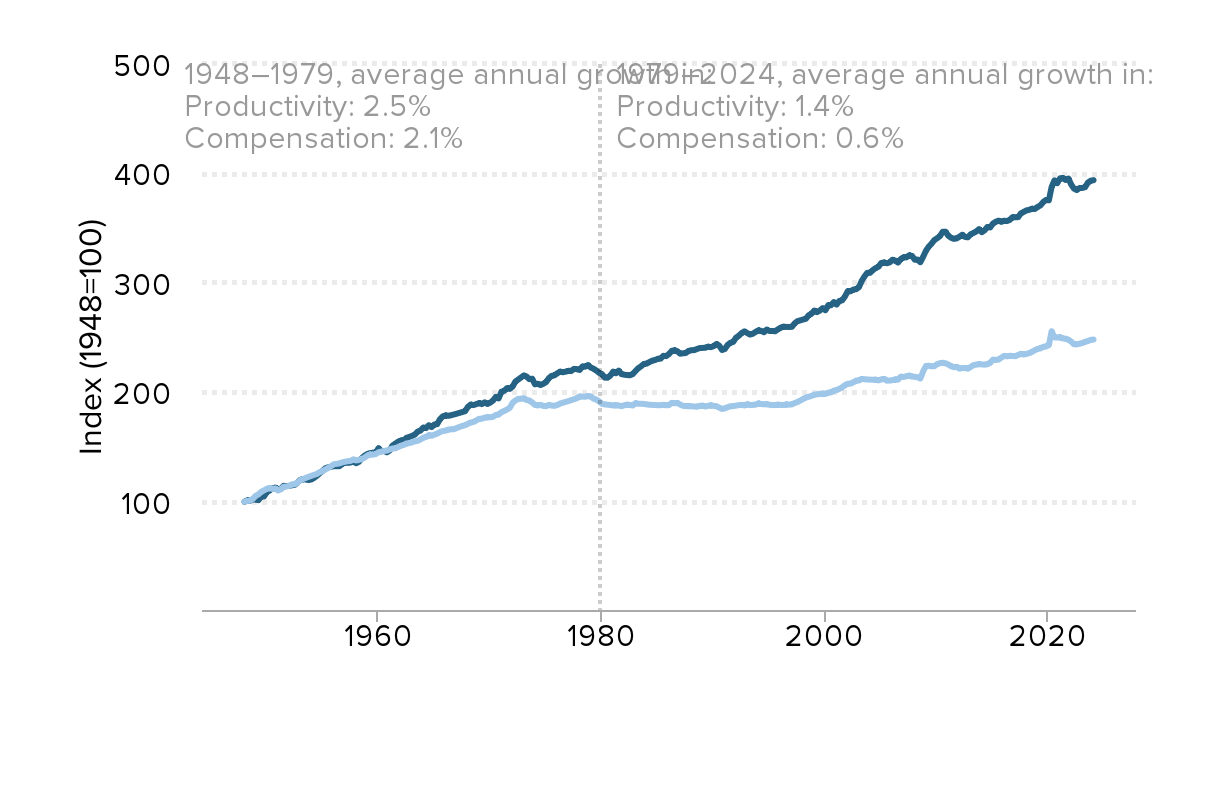
That's not really how it worked out so far, the productivity is simply pocketed by the elite and never translates to shorter work week, salary increase or earlier retirement

https://files.epi.org/charts/img/235212-28502-body.png

MSFT_Edging 11 hours ago
Then they would be paid for 5-10 hours and have to ask the government for benefits.

In what world would a corporation pay a full yearly salary for 1/8th to 1/4 the labor hours? The current world already looks to labor as the juiciest place to cut cost for the profit margin.

HPsquared 11 hours ago
That's not enough time to maintain skill. Experience would build very slowly in people working so intermittently.
thatguy0900 11 hours ago
Someone is working 20 hours a month and paying for a 100$ subscription on top of bills? And this isn't a isolated case, this is the expectation for the normal person? Is the job supposed to be real or is the government just giving out universal basic income while being petulant about people not working at all
boh 9 hours ago
Banks hedge investments-it's pretty standard and lowers their risk-weighted assets. If their investments are big, their hedges are big. If banks have a net negative view towards their AI investments, this article fails to articulate that (regardless of how many exciting adjectives they choose to use).
spwa4 9 hours ago
$5 trillion dollars in loans? Pretty standard?
boh 3 hours ago
I think you're filling in the blanks for a pretty detail light-broad brush-click baity article. The $5 trillion that it cites is by its own words what they're "expected to spend". Also the global bond market is trillions of dollars worth and yes it is typically hedged.
alecco 11 hours ago
https://archive.ph/kwD1t

> Banks are lending unprecedented sums to technology giants building artificial intelligence infrastructure while quietly using derivatives to shield themselves from potential losses.

And who is their counterparty? Aliens? What a dumb click-bait article.

jesuslop 10 hours ago
Is there a web that calculates implicit credit ratings of the hyperscaler companies?
vb-8448 11 hours ago
One thing it's not clear to me: the amount of money is colossal, where the one who are supposed to refund banks will get the money?
thewebguyd 10 hours ago
> where the one who are supposed to refund banks will get the money?

Liquidating other assets. The point of the banks using SRTs is to push the default risk off of the bank and onto investors.

So now, instead of banks failing, private credit gets to bear the risk of the bubble popping. Since they can't sell the (now bad) AI debt, they will need to liquidate all of their other assets to pay the banks.

That's why a potential AI bubble burst can cause the markets to enter a death spiral and bring down a bunch of other, unrelated markets.

If private credit can't cover the losses by liquidating everything else, well, then they fail, and we either let it all crumble or do bailouts again.

spwa4 8 hours ago
You forget the single greatest source of money for investors: loans. Sorry "margin". With the banks. And margin is nonnegotiable because the whole point of the stock market is to massively increased loaned money because that is the real advantage to the economy they provide.

Plus the problem of 2008. You cannot offload risk if everything is synchronized, the math still works but doesn't take "either everything crashes or nothing does" into account.

hackable_sand 4 hours ago
Needs to pop faster.
voxleone 11 hours ago
Looks like we might be witnessing a textbook cycle of self-fulfilling prophecy in the making. As the article suggests, once large investors and institutions start calling this an “AI bubble,” the narrative alone can drive more capital, inflating valuations further just because everyone expects growth. When price → expectation → price becomes the dominant feedback loop, fundamentals matter less.

That kind of reflexivity has powered past bubbles. George Soros’ reflexivity thesis applies: rising prices attract more investment, which inflates prices further, until reality forces a reset. If many AI-related companies can’t quickly deliver expected growth, the eventual correction could be sharp.

In short: hype begets cash, cash begets price, price begets more hype, and at that point, we’re no longer betting on value, we’re betting on the belief itself.

jtf23 12 hours ago
profits have not materialized, nor can they: machines can only transfer value, they cannot create it
mikepurvis 11 hours ago
Two responses to this:

- Most participants in the economy are creating very little real value. They're shifting things around or temporarily solving problems that are highly localized to the organization they're in.

- There's a lot of unrealized value stored in the corpus of knowledge that AI companies have ingested— the millions of webpages, the scanned books, wikipedia, the blogs and Q&A sites. So even if AI companies are not creating new insights, just the act of locating, filtering, and summarizing knowledge that was already present somewhere in the world is valuable. Indeed, one could use this same argument to declare that Google in 1999 was creating no value, which is of course obviously untrue.

zerotolerance 10 hours ago
Google created two kinds of value: content discovery via connection (value to the consumer), and market reachability for advertisers. Oh, and also the world's most inconvenient spell check.

AI proposes to solve: a content supply side problem which does not exist, and an analysis problem which also only maybe exists. Really what it does in the best of cases (assuming everything actually works) is drive the cost to produce content to zero, make discovery less trustworthy, make the discovery problem worse, and launder IP. In the best case it is a net negative economic force.

All that said, I believe the original comment is about the fact that the economy exists to serve market participants and AI is not a market participant. It can act as a proxy, but it doesn't buy or sell things in the economic sense. Through that lens, also in the best case the technology erodes demand by reducing economic power of the consumer.

That said, I'm stoked to hear about the next AI web site generator or spam email campaign manager. Lets setup an SPV to get it backed off-balance sheet.
Nasrudith 6 hours ago
Wow, I didn't think I would find worse economic theory than the labor theory of value. Although this may just be some offshoot's particularly stupid interpretation of LTV that takes its articles of faith and concludes that since machines don't do human labor they must be stealing it from the workers.
ubercow13 12 hours ago
What?
jtf23 12 hours ago
it turns out capitalists do not understand economics