What do they do differently?
[1] https://en.wikipedia.org/wiki/Santiago_de_Compostela_derailm...
[2] https://en.wikipedia.org/wiki/2026_Adamuz_train_derailments
Reminds me of when Malaysian airlines crashed two planes in a short period of time. It was a good time to get cheap flights from Europe to south east Asia as long as you can withstand relatives thinking you are literally going to die in their third crash.
And up to that point Russia wasn't known to supply the separatists with an anti air system and the crew to run it.
It absolutely did not. The RCS of an F-14 v/s an Airbus A300 is an order of magnitude different (probably 2 or 3 orders).
> There really was an F-14, just on the ground at an Iranian airbase
There was, but that’s a red herring for the root cause. Each ship’s radar independently and correctly identified and tracked the Airbus separate from the Mode 2 targets, but when communicating the track information between ships, the tracks were mixed up.
Source: The US Navy’s own account: https://www.history.navy.mil/content/history/nhhc/about-us/l...
> There was a combat camera team aboard the Vincennes, and the footage depicts considerable confusion and even ill-discipline amongst the crew (cheering, shouting, football game atmosphere) that contributed to one of the most tragic events in U.S. Navy history
I'm outside the US so that's probably the cause. Is such information available elsewhere?
But this also works: https://archive.md/XsxT8
And also this: https://web.archive.org/web/20251208110440/https://www.histo...
Don’t fly a commercial passenger jet over an active known war zone. Then you don’t even really have to think about whether the separatists below you know whether your signature looks like a fighter jet or not lol.
Never leave your safety to the vagaries of Russian incompetence or malice, surely.
I'm not sure why Girkin would want to shot down an airliner?
[1]: https://www.technologyreview.com/2014/07/18/12951/how-can-a-...
[2]: https://www.washingtonpost.com/news/the-switch/wp/2014/07/18...
It absolutely matters.
Flying over a war zone with known anti aircraft missiles is quite different to flying over a low level conflict that is using small arms only.
What was in the news at the time, and the news are still linked from https://en.wikipedia.org/wiki/War_in_Donbas#Escalation_in_Ma...
2 June 2014: "Luhansk airstrike"
14 June 2014: "A Ukrainian Air Force Ilyushin Il-76MD was shot down"
20 June 2014: "The insurgents [...] shot down a Su-25 bomber."
14 July 2014: "Ukrainian Air Force launched air strikes targeting insurgent positions across Donetsk and Luhansk oblasts. The Ukrainian government said that 500 insurgents were killed"
17 July 2014: "DPR forces shot down a civilian passenger jet, Malaysia Airlines Flight 17"
as long as you can withstand relatives thinking you are literally going to die in their second crash,
and then you die in their second crash.
https://www.reuters.com/world/spains-deadly-rail-accidents-p...
> [The] stretch of track that was renovated last May and inspected on January 7.
The track had been inspected very recently. Maybe the inspection standards are inadequate?
The linked article also shows figures that are quite meaningless without context.
> [The] vast majority [of Spain's high-speed rail budget] went to new infrastructure with only some 16% earmarked for maintenance, renewal and upgrades. That compares with between 34% to 39% spent by France, Germany and Italy,
They simply can't compare those numbers as-is. Of course Spain will be spending less in maintenance as a percentage of the total budget if it's still mainly building new tracks. It's not a useful figure.
Spanish officials are very good at deflecting blame and playing politics. Nobody wants to be held accountable for a catastrophe. Also see the 2024 floods in Valencia; a partially preventable tragedy, followed by a whole lot of mud slinging, but zero accountability.
So while inspection standards might be inadequate, I would take anything a senior official says with a pound of salt.
sigh
Of course you're right
Conflating the maintenance budget with the money invested in new infrastructure in this way is not very useful IMHO. How much inspection/maintenance money was spent per km of (high-speed and overall) railway track would be much more informative...
English has a third term like that as well called 'brazing', then there is silver solder (a high temperature version of soldering), in dutch we'd call that 'hardsolderen', whereas what the English call brazing we call oxy-acetyleen lassen (which is more of a process name by virtue of naming the ingredients).
Soldadura autogeno and Soldadura en el arco (sp?) are what I think the modifiers used in Spanish to indicate brazing and (arc) welding.
In Germany it would be schweißen.
So, also different with different etymology in a language from a different group (although these things were probably influenced by German)
* the first one makes it clear a something (a different material) is used to join things together
* the second one implies you melt/boil the things to join them together
Seriously, Cryptonomicon is a bizarre thing to put on this list. I like the it a lot, but none of that book takes place in Japan and the closest intersection is Japanese soldiers during World War II, with a brief participation of a single fictional Japanese company in the modern section of the book.
While this protocol is not oriented toward maintaining equipment like tracks and wheels -- it does seem to be a good indicator that the Japanese deal with these systems and the safety concerns around them differently.
And their track record (pun intended) shows the result of this focus.
https://en.wikipedia.org/wiki/Pointing_and_calling
> Railways in Japan use a safety system called “pointing and calling.” This method of physically pointing toward an item to be checked while vocalizing its name was invented in Japan about 100 years ago. The combination of looking, acting, speaking and hearing reduces errors by as much as about 85%.
I love Cryptonomicon but it engaged in that distinctly American brand of orientalism when it got into Japanese soldiers killing themselves and whatnot.
My tentative conclusion is that there is something really unique about Japanese culture and there is certainly nothing wrong with that.
These are actually points making the Japanese system easier to maintain. Because of smaller surface area it’s much denser.
The first was purely a matter of not upgrading the signaling in a very low speed section: The crash could have happened with regional trains too. Every engineer knew that it was unsafe and one distraction was enough to get someone killed, but Spain is still well in the middle of track expansion, so it's all the horrors of politicking. Unless you have a crash, not upgrading those signals costs nothing, but, say, the very expensive connection to Asturias was worth a lot, so iffy tradeoffs were made.
Hopefully better engineering-driven tradeoffs are made regarding track maintenance, but hey, this is Spain, not a place where we are good at efficient, reliable safety processes: See the failures in Valencia for the DANA, where the chain between the meteorologists seeing a risk that led to recommending evacuation, and the actual order of evacuation was so slow, so we ended up with 229 deaths.
They run at full speed between regular train operations.
I saw one of them running on my last trip, which is said to be good luck.
Also, Far East right now is also massively cash poor yet labor rich relative to the rest of the world. Everything is crazy undervalued and there are clear gaps between amounts of money changing hands vs work being done. Skilled-labor-intensive tasks are going to be much easier when cheap skilled labor is just perpetually available.
1) Can you expand on your first sentence? When you say user owned what does that mean exactly?
2) If skilled labor is undervalued does that mean those with those positions live kind of meager lives? Or what is that like?
2) I mean, like, it's the place where the English loanword for "death by overwork" came from. Also, undervalued means things costing less than they are worth. Trash costing little isn't undervalued, that's more adequately valued.
Answer 1 is still not clear to me. Can you contrast it with how Spanish track is managed?
I admit that I was a bit uninformed about specifics of Spanish train system in that, the rails were in fact laid by then-Spanish national rail and the operator was then-national company, but still, they don't seem like built and maintained like the BART or the NYC subway that happens to go 200mph in straight sections. That Shinkansen architecture is unique, and that is also guaranteed to be more labor intensive than how everything in most HSRs are.
High public competency and government capacity allows a lot to get done.
This means that Shinkansen tracks are designed and build to much higher standard.
Which is the secret of preventing 99%+ of sudden mechanical failures of pretty much any type of infrastructure.
Accountability.
Japan having to build to earthquake standards, so being more robust overall? Or to specific failure modes, at least.
BART recently got a full-speed inspection car.[1] They needed a specially built one because BART has a non-standard track gauge.
The Federal Railroad Administration has track inspection cars, but only six of them for the whole country. One was seen on CALTRAIN track.[2]
Hey that infrastructure looks perfectly fine and new, ahhh ok... they were going 180kmh where the speed limit was 80kmh..
These events happening 4 times in 3 days are statistically nonexistent. Even less existent is them starting to happen right on the day before a major politician in Spain visits Israel to talk about buying Israeli security and monitoring systems.
Now - Japanese mentality is strange to me, but the quality standards and thought process, are convincing.
0. https://old.reddit.com/r/drehscheibe/comments/1qe9ko2/ich_gl...
That entirely depends on which class of tracks we're talking about. And on top of that, remember that Europe is at war with Russia, railway sabotage has been attributed to Russia already in Poland [1] - and if you ask me, I don't believe for a single goddamn second that "cable thieves" were the cause behind the infamous 2022 attack on Germany's railways [2] either.
> And what systems are in place to actually detect this.
In Germany, dedicated railway cars called "RAILab" [3] that can measure track performance at up to 200 km/h perform the bulk of the work. In addition, each piece of infrastructure has something called an "Anlagenverantwortlicher", a person responsible for it - and that person has to walk each piece of infrastructure every two years at the very least, sections that have shown to be problematic get walked sometimes weekly.
[1] https://www.bbc.com/news/articles/c4gknv8nxlzo
[2] https://en.wikipedia.org/wiki/October_2022_German_railway_at...
The German Federal Police has nothing to gain by lying about this incident. They explicitly investigated the possibility of foreign sabotage, found the perpetrators, and concluded that it was just regular theft. Sometimes a horse is just a horse, even when there are zebras running around.
And yet, there are multiple different theories floating around on who bombed North Stream. The police and DA assume that Ukrainians were behind this mess, possibly under orders of back-then UA army chief Zaluzhnyi according to leaks and rumors, but official communication on that has been ... lacking and that's putting it mildly. It doesn't help that there are credible suspicions of Russia being behind it either, the only theory I'd move to the "conspiracy bin" is that it was a CIA operation.
When it comes to anything involving this war, there really is no reason to trust anyone.
> They explicitly investigated the possibility of foreign sabotage, found the perpetrators, and concluded that it was just regular theft. Sometimes a horse is just a horse, even when there are zebras running around.
I agree... but still, the timing is so incredibly close that it's just as possible that for once the cable thieves were capable of good OPSEC practices.
Most railways regularly inspect their tracks to detect issues before they turn into a disaster. The big question here will be: why wasn't this caught earlier?
As the article notes: the initial break left marks on the wheels of several previous trains. The final gap is big enough that no train could possibly make it past it, so it is pretty clear that the gap got larger as the incident progressed.
very
> And what systems are in place to actually detect this.
track circuit detection would pick up most cases I would have thought
Provided track circuit detection is even used, of course. I vaguely recall it not being compatible with either 25kV electrification or high-speed rail in general, and most modern tracks therefore using axle counters instead.
Track circuits aren't incompatible with that per se, but axle counters are simply easier to install and much more maintenance-friendly – no longer having to worry about
- mixing track circuit currents and traction return currents together
- having to keep the rails sufficiently isolated from the ground and each other to prevent the track circuits from falsely showing occupied
- insulated block joints
- having to use each bit of track once every twenty-four hours to prevent rust from falsely showing a track as clear
- extreme leaf fall and/or sanding potentially causing false clears, too
- length restrictions on the maximum length of a single track circuit, although that's only really a problem on more sparse trafficked lines with long block sections
In return, axle counters have the drawback that they
- don't detect broken rails (although it needs to be said that track circuits very much aren't perfect broken rail detectors, either)
- can be falsely reset (with more or less protections, depending on local operating practices)
- don't detect maintenance vehicles freshly placed upon a track until they enter the next axle counter section
but since most to almost all new installations seem to use axle counters, the trade-offs are apparently worth it to infrastructure operators.
1. According to the CIAF, the break in the track was "practically undetectable." The fracture on the track was not noticed by the trains that passed over it, or by the technicians responsible for the maintenance of the infrastructure.
2. The damaged train, which belongs to the Italian company Iryo, is heavier than other trains running on the track; the additional weight of the Iryo train may have been a factor, or possibly even one of the causes, of the derailment.
3. The CIAF said that the notches registered in the wheels and the deformation in the rail are "compatible" with the fact that the track was broken before the Iryo train passed over it.
4. Spanish Transportation Minister Óscar Puente rejected criticism of the delay of the rescuers; according to the Minister, rescuers arrived within "18 minutes."
The full article is available here: https://www.jornada.com.mx/2026/01/24/mundo/020n3mun
Fun fact: the reason modern concrete or composite sleepers (e.g. [1]) have a slightly concave profile is to better resist lateral forces (i.e. buckling) than traditional straight-profile wooden sleepers.
[1] https://www.romicgroup.com/permanent-way/concrete-railway-sl...
This sounds like something a camera mounted on a sample of trains watching a wheel could catch.
https://de.wikipedia.org/wiki/RAILab
https://en.wikipedia.org/wiki/Doctor_Yellow
https://en.wikipedia.org/wiki/SNCF_TGV_Iris_320
https://people.com/train-collides-with-crane-arm-in-4th-rail...
It's clear some of them are probably caused by neglect in maintenance, others are freak accidents.
It's pretty crazy the statistical probabilities involved for something like this.
An Asturias Circanías train collided with debris from a collapsed tunnel wall on Thursday afternoon in Olloniego. No injured though
High-speed lines (AVE): Visual and geometry inspections are performed daily to weekly using inspection trains and onboard measurement systems. Ultrasonic rail flaw detection is typically done every 1 to 3 months, depending on traffic and tonnage.
Source: ADIF high-speed maintenance programs and EU interoperability maintenance requirements.
It seems a shame that a few other trains passed beforehand with this anomaly in place and yet it went undetected.
For example, in the U.K.:
Germany: https://de.wikipedia.org/wiki/RAILab
Japan: https://en.wikipedia.org/wiki/Doctor_Yellow
France: https://en.wikipedia.org/wiki/SNCF_TGV_Iris_320
China: https://en.wikipedia.org/wiki/China_railways_CIT_trains
> Line inspection is carried out at full speed, up to 270 km/h or 168 mph on the Tōkaidō Shinkansen and 285 km/h or 177 mph on the Sanyō Shinkansen
Under "rail break monitors" it mentions both electrical continuity and time-domain reflectometry can be used, and are most frequently used on high-speed tracks.
In addition, there are vast array of other detectors using acoustic sensors, strain gauges, accelerometers, cameras in the visible and infrared spectrum or laser measurement, that potentially could have detected an anomaly (i.e. damage to the wheels of other trains before the incident).
[0]: https://en.wikipedia.org/w/index.php?title=Defect_detector
We squeezed some track condition monitoring hardware into some locos but it was single-driver operations locations and we cannibalised some of the room that would have otherwise been occupied by the second driver.
It measures vertical forces in kips - (kilo-pounds-force, 1 KIP = 1,000 lbs)
They have these in the USA.
Though conceivably the break was very small and a train impacting the slightly lifted rail just caused a good chunk of it to explode.
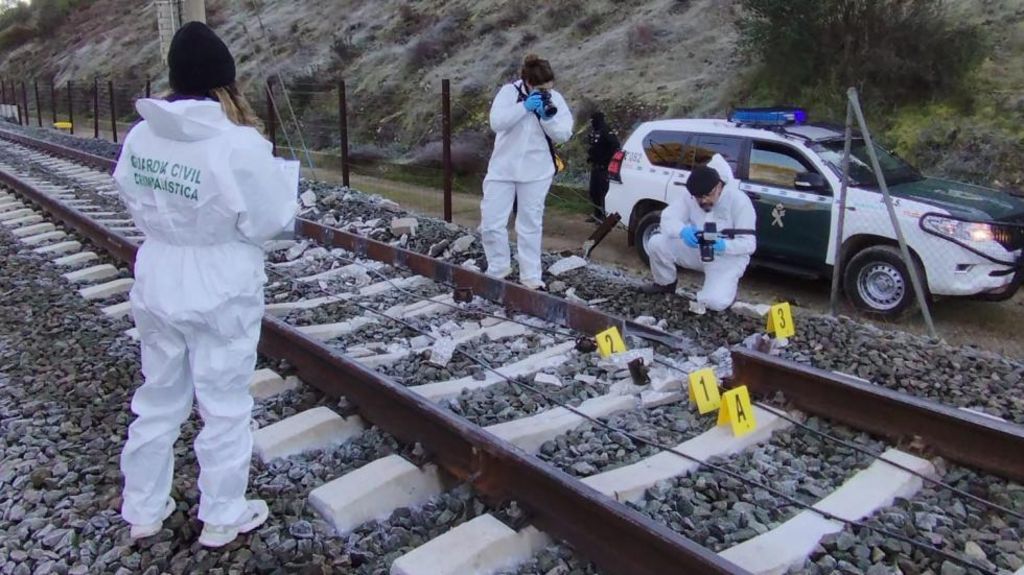
The crown (top) of the rail seems to be missing after the gap. The crown-less section then continues ~3 meters before it disappears behind the investigator on the left. IDK what that might indicate.
ref pic: https://ichef.bbci.co.uk/news/1024/cpsprodpb/ecb4/live/53924...
edit: other angles of the same location here: https://youtu.be/DIQ4SrGSua0?t=1174
Ah, I see it now. The marks from contact with the ties should have clued me in earlier.
The crack was in the weld, causing one side to sink and the wheel to hit the start of the next section of rail which was no longer welded to it, causing stress fractures to form in the rail which later caused that 40cm piece to break off.
And how does it accord with the many statements made early on about the track being renewed recently?
Still the media in question, "El Mundo", is a mouthpiece for the opposition parties, seeking to create indignation against the government and scoring the head of the Transport Minister in particular.
They also want to make a parallel with the situation of the former President of the Valencian Community, from their party, who had to finally resign one year after being unreachable for hours on a date while hundreds of valencians drowned as his administration waffled aimlessly.
Of course the government is ultimately responsible for the state of the infrastructure, so the Minister well might have to resign after all is said and done, but the innuendo in that piece is pure politicking, not serious journalism.
https://www.elmundo.es/economia/2026/01/25/697635e8fc6c83c42...
I think these kinds of accidents are largely mitigated by rail defect monitoring. I know rails in the US are equipped with defect detectors for passing trains; I'm surprised that a similar system doesn't exist for the rails themselves. Or more likely, one does exist and the outcome of this tragedy will be a lesson about operational failures.
the more you build the more maintenance costs rise.
That's simply really, really rare bad luck.
Practically anything you can think of is going to be a more effective use of safety resources than trying to contain a derailing high-speed train.
Also the issues other comments described, including that any fault in the barrier means a new safety hazard
But that requires the trains mostly always being on schedule.
Spain needs to rethink the way it operates trains. I think Switzerland handles this better, overall, though they probably also don't have as many fast trains because there are so many mountains. But I refer more to the intrinsic quality control and assumption made. If I recall correctly in Spain, there was the other train also coming in. I am sure they could have built the tracks differently. Granted, the issue here is cost, and an attempt to keep the cost down, but if you then accept disasters like that, it seems really awkward to me to want to save money here. And now that we know the track was already damaged, that just adds more validity to questioning whether the quality control systems were overall proper.
I could make a cheap shot about fires in bars...but I won't.
Distance isn't even remotely relevant to complexity of running safe operations.
Data like fatalities per 1 million kilometers driven is significantly more relelvant - all metrics at which Swiss railways significantly exceed any European rail despite operating at significantly larger density of traffic.
Spanish railways have lately killed a horrifying amount of passengers - perhaps instead of insulting more competent operators, it's time to look at what keep going wrong there? Any responsible person would call for experts and advice here - e.g. we commonly see thet in air safety where foreign safety experts are invited to investigate and provide their own reports and recommendations.
What you seem to be doing here is something directly opposed to it and very very toxic - nationallistically trying to insults others and save face, which is very contraproductive for future safety.
Ad hominem so I'll discard most of your post. You lose when you try to insult my character.
> Spanish railways have lately killed a horrifying amount of passengers
Swiss bars have lately burned a horrifying amount of customers. Get your own house in order :)